 Movie the Needle
Okay, yes, it’s in the eye of the beholder. There are good modern films. There were bad old films. We remember the good ones and quietly allow the rest to disappear, which gives the past a fairly considerable advantage.
I know.
This isn’t some misty-eyed, boomer-esque take on how everything was better in my day. I’m a millennial. Everything was actually better in my day.
More seriously, though, I don’t think every complaint about modern cinema can be dismissed as nostalgia. There are changes in how films are made, what they prioritise and what they expect of us that deserve rather more consideration than “you’re getting old”.
I’m not even talking about the creative cul-de-sac of franchises, sequels, reboots and cinematic universes. That’s linked, obviously, but it’s a whole other article. An original story can suffer from everything I’m about to complain about. A sequel can avoid all of it.
And some things have improved. Digital tools have opened filmmaking up to people who couldn’t previously have afforded it. Visual effects can achieve extraordinary things. We have easier access to films from around the world, and more opportunities to hear from people Hollywood historically wasn’t terribly interested in.
Those are gains. I’m not campaigning to confiscate everyone’s cameras and make them film exclusively in 1978.
But I do increasingly find myself watching something expensive, accomplished and technically impressive, and wondering why it feels so lifeless.
Films have got bigger. Their worlds often feel smaller.
Two and a half hours in a hurry
One of the strangest things about modern films is that they don’t take their time, despite taking absolutely loads of mine.
Everything is urgent. Every scene must deliver information, set something up, pay something off or remind us of something we’ve apparently already forgotten. There’s barely room for someone to sit down and be a person.
And yet the thing goes on for two and a half hours.
There’s nothing wrong with a long film. There’s something wrong with a film being long without getting anything out of it. If you’ve got time for another explanation of the plan, surely you’ve got time for a conversation that makes me care whether the people carrying it out survive.
Jaws finds room for three blokes drinking, comparing scars and talking on a boat. That scene doesn’t interrupt our investment in the shark hunt. It gives us more of it. We spend time with them. Their relationships change. They become better company.
That’s doing something, even if nobody’s pointing at a map.
Too often, the bits that get treated as expendable are precisely the bits that would make the film worth spending time with. Atmosphere. Awkwardness. A conversation that goes somewhere unexpected. A moment allowed to linger after its immediate purpose has been served.
Instead, we get more plot. Then an explanation of the plot. Then someone expressing concern about the plot.
Yes. I’m concerned about it too.
The overexplaining is particularly wearing because it comes in several flavours. Sometimes the film doesn’t trust us to follow what’s happening. Sometimes it doesn’t trust us to understand how somebody feels. Sometimes it seems terrified we might misunderstand its position on what somebody’s just said.
A character can’t simply behave badly. Someone has to identify the bad behaviour. An uncomfortable moment can’t remain uncomfortable. It needs a response that reassures us the film knows it’s uncomfortable.
I don’t need every character to have the correct opinion. I need them to feel like people. People can be wrong without the screenplay immediately producing a witness for the prosecution.
Then there’s the inability to leave sincerity alone. Someone says something heartfelt, and another character arrives with a quip to take the edge off. The film has briefly risked caring about something and would like us to know it’s embarrassed.
Humour can absolutely belong in an emotional scene. But when it becomes a reflex, I start to wonder why I’m being asked to invest in something the film keeps distancing itself from.
Let the moment happen. I might feel something. That would be nice.
I might not have a lot of examples for this stuff, this is just a middle aged man shouting at a cloud, but it's how I feel when I'm watching modern films, and how I feel matters a lot to my film watching experience. Much more than what I think.
Made for distracted viewers
There’s also a rather less philosophical explanation for some of the repetition: films are being made with distracted viewers in mind.
In his n+1 essay “Casual Viewing”, Will Tavlin reported that screenwriters working for Netflix had received notes asking them to make characters announce what they were doing, so people watching in the background could follow along.
That’s a specific reported practice, not proof that every modern screenplay is written for someone scrolling through their phone. But it’s a fairly depressing thing to accommodate.
Because what happens to the person who is watching? The person who noticed the look, understood the implication and remembered the conversation from ten minutes ago?
They get to sit through it being explained anyway.
And if looking away means missing very little, you’re hardly giving people much reason to keep looking. At some point, making films for people who aren’t watching them starts to feel like a self-fulfilling prophecy.
When the light stops belonging
Then there’s how they look.
I’m tempted to call it “digital light”, although that bundles several different things together. Digital cameras, LED lighting, colour grading and the actual choices about how to light a scene aren’t interchangeable. You can use modern equipment and make a beautiful image. You can shoot on film and make a horrible one.
What bothers me is the polished, strangely weightless look that seems to follow so many productions regardless of where or when they’re set.
A room is supposedly lit by a fire and a couple of candles, yet the people in it look ready to discuss their skincare routine. The costumes tell me it’s the past. The light tells me someone’s about to sell me a subscription.
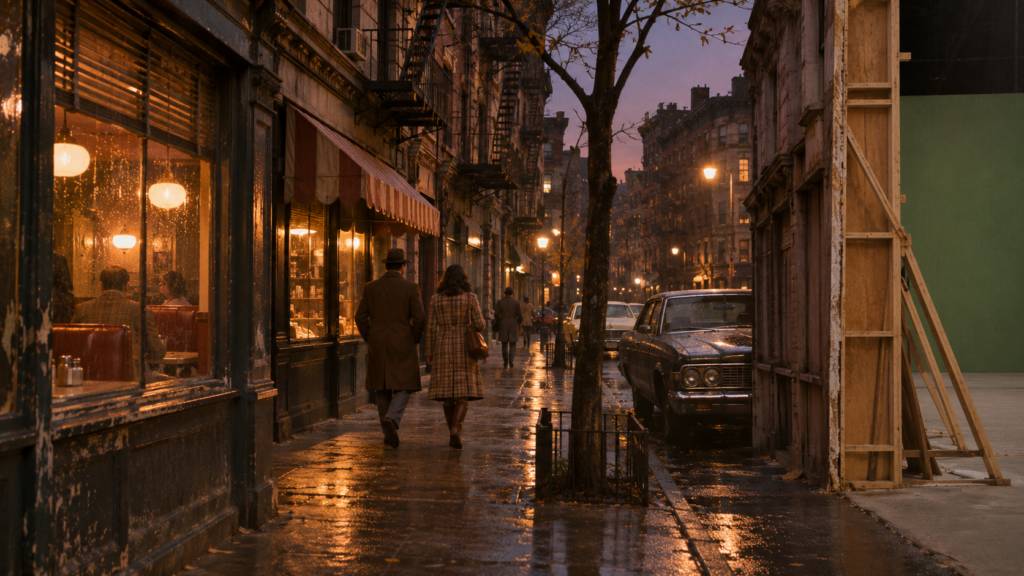
I want the light to belong to the place. I want darkness where there would be darkness. Faces with shape. Rooms with corners. Some sense that these people occupy an environment rather than standing in front of one.
And no, that doesn’t mean making everything so dark I have to close the curtains and adjust the television to identify a chair.
The Holdovers is a useful example, because its period look was achieved with digital photography and extensive use of LED lights. The equipment plainly isn’t preventing anyone from making a film feel like it belongs to its setting.
Which makes the blandness elsewhere more frustrating. It’s a choice, or a series of choices. We don’t have to settle for it.
The convenience of CGI
The same goes for CGI.
I’ve no interest in pretending every practical effect is convincing just because somebody physically made it. Some people love the grotesque inventiveness of The Thing. Others can admire the craft and still see rubber. Go further back and the gap between what a film wants you to see and what you actually see can become considerable.
CGI has helped close that gap. It can be astonishing. A lot of the time, it’s so good we don’t even recognise it.
The Movie Rabbit Hole’s series on invisible CGI is worth watching for precisely that reason. We tend to blame CGI when we notice it and credit something else when we don’t.
But there’s a use of it that bothers me far more than a slightly unconvincing monster.
Why go to a location when you can put the actors in front of a screen? Why build the whole room? Why commit to what’s outside the window when someone can decide later?
Of course filmmakers have always used painted backdrops, models and rear projection. Of course digital work can be expensive and painstaking. This isn’t an accusation that the artists doing it are lazy.
It’s a complaint about the decision to use their work as a substitute for committing to the physical world of a film.
Making the impossible possible is exciting. Making the possible more convenient for the production is rather less exciting, and you can often feel the compromise on screen.
And if you think AI will be used to add artistic value, rather than to save money wherever a company thinks it can get away with it, then I’ve got some magic beans to sell you.
That’s capitalism, folks. The fact that a tool can do something wonderful tells you very little about what someone will pay to use it for.
Everything is an event
And all of this happens against a backdrop of more films than any of us could reasonably keep up with, accompanied by the insistence that every year is another extraordinary year for cinema.
The sheer volume is another article. Streaming, content, the apparently urgent need to give us something else to half-watch while we decide what to watch. But the hype is exhausting. Everything is essential. Everything is an event. Every awards season arrives with another collection of masterpieces we’re supposed to feel privileged to have witnessed.
Really? Every year? How fortunate.
Anyone who follows football in the UK will recognise this. Sky Sports has spent years trying to convince us that every fixture is an unmissable sporting occasion. MONDAY NIGHT FOOTBALL. Bournemouth versus… checks notes… Hull City. A pulsating 0–0 draw in which the most memorable contribution came from a crisp packet.
Obviously, I’m making up the fixture, and the snack based event, but you'll recognise the hype.
And you know why they do it. They’ve paid for the football. They’re selling you the football. They can hardly spend the build-up saying, “Honestly, this probably won’t be very good. Ring your mum instead.”
The business depends on the thing being worth your time and money, so the thing must constantly be presented as worth your time and money. Whether it actually is becomes a slightly awkward secondary consideration.
We’re back to capitalism again. Sorry. It does keep turning up.
Cinema has its own version of this. Studios need an event. Platforms need something you can’t possibly cancel your subscription before seeing. Awards campaigns need greatness. And somewhere in all that, “this is quite good” becomes an insufficient return on everyone’s investment.
There are critics and audiences pushing back, obviously. I’m not suggesting everyone’s in on some grand conspiracy. I’m saying the machinery is never going to announce that it’s had a mediocre year. It just carries on producing the same level of excitement regardless of what it’s actually got to be excited about.
Tiresome.
My wet dream is that one year the Academy comes out and says, “It’s been a crap twelve months, frankly. I don’t think we’ll bother this year. See you next time.”
I’d respect that enormously.
Because “the best film this year” and “a great film” aren’t necessarily the same thing. Someone finishes top even when everyone’s had a stinker.
The death of the extra
But beneath all that noise, there’s one thing that bothers me most. In a packed field, my winner is the death of the extra.
Not literally. And I’m not pretending I’ve counted every background performer employed since 1985. I mean the disappearance, in too many films, of the feeling that there are other people living in this world.
Strictly speaking, once someone has scripted dialogue, we’re generally talking about a small speaking part rather than an extra. Fine. I miss them too.
The receptionist. The barman. The bloke trying to get his work done while the main character causes a problem. Someone who has one scene, three lines and priorities that don’t begin and end with helping our hero.
They give the world a life beyond the story.
Watch the opening of Dog Day Afternoon. New York exists before the robbery becomes our concern. Traffic, people, neighbourhoods, an ordinary day getting under way. What happens in the bank feels like something happening within a city, rather than a city having been provided to accommodate something happening in a bank.
Beverly Hills Cop gives Detroit that same immediate presence. The opening montage lets you feel a place before Axel’s story takes over. Later, the contrast with Beverly Hills means something because we’ve been shown the difference.
And look at the Copacabana sequence in Goodfellas. We move from the street through the working parts of a nightclub and into the room. People greet Henry, work around him and make space for him. The place is full of activity, and his relationship with it tells us who he is.
You could convey the basic information with a line about how Henry knows everyone.
You would lose almost everything that makes it worth conveying.
These aren’t interchangeable establishing shots. They let us understand how a place fits together and how people move through it. A skyline tells me which city we’re in. It doesn’t necessarily make me feel we’ve been there.
Top Gun and Top Gun: Maverick are an interesting comparison here, partly because I really like Maverick. This isn’t a case of old one good, new one bad.
The original gives me incidental people I remember. The officer whose coffee gets spilled when Maverick buzzes the tower is a tiny role, but he has his own grievance. For a moment, our exciting hero is simply the idiot making someone else’s working day worse.
That’s useful. It makes the base feel like a workplace as well as the setting for Maverick’s story.
Top Gun: Maverick is more tightly organised around its mission and its central relationships. There’s a focus to it that works tremendously well, but I do miss some of that incidental texture.
It would be wrong, though, to pretend its world is empty. The Hard Deck bar scene used around 100 actors in a purpose-built set. It’s busy, social and allowed to take up space in the film. It’s an example of what I want more of.
The distinction isn’t simply how many bodies you can count. It’s whether those people seem to belong there. Whether they have something to do. Whether the film gives them a moment in which they’re more than furniture.
All of this takes work. A populated street needs people, movement, continuity and coordination. A small speaking part needs casting and time. Moving through a location means thinking about how its spaces connect.
An empty patch of pavement and a couple of close-ups can avoid an awful lot of that.
Sometimes that’s exactly what a scene needs. Sometimes the absence of people is the point. But when everything outside the central cast feels conveniently cleared away, I stop believing in the place.
I start seeing the production.
And that’s why these complaints belong together. Cut the time spent arriving somewhere. Cut the incidental conversation. Cut the person whose contribution doesn’t advance the plot. Replace the location with something more controllable. Explain whatever the audience might have missed.
Individually, you can justify every decision. Collectively, you can suck the life from a film.
I don’t need every modern release to look like a seventies crime drama. I don’t need grain, cigarettes and a man in a brown suit to tell me I’m watching proper cinema.
I want the feeling that the world carries on beyond the frame. That the people we pass have somewhere to go. That a conversation might be worth hearing even if it isn’t giving me instructions.
Modern films can show me entire cities being destroyed.
I’d quite like to believe someone lived in them first.
Sources and clips
- Will Tavlin: “Casual Viewing” (n+1) — Reporting on Netflix screenwriting notes and viewing with divided attention.
- “The ‘Film Look’ and How The Holdovers Achieved It” (Filmmaker) — How digital photography, lighting and colour work created the film’s period look.
- The Movie Rabbit Hole: “‘NO CGI’ is really just INVISIBLE CGI” — The first video in the series about digital effects that audiences often don’t notice.
- Goodfellas: the Copacabana sequence — The tracking shot discussed in the article.
- “How Top Gun: Maverick’s Electric Bar Scene Took Flight” (Vanity Fair) — Interviews about the Hard Deck sequence, including its purpose-built set and roughly 100 actors.
Comments